
Agent to Agent Testing Platform vs Project20x
Side-by-side comparison to help you choose the right product.

Agent to Agent Testing Platform
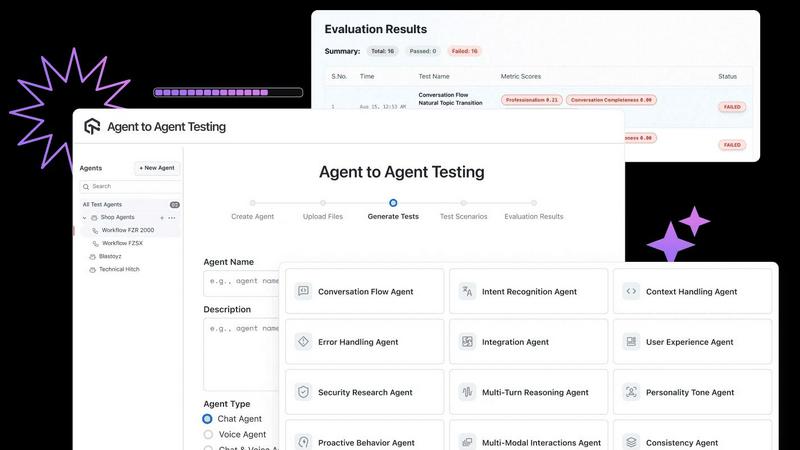
Validate AI agent performance across chat, voice, and phone interactions to ensure safety, compliance, and reliability.
Last updated: February 27, 2026

Project20x
Project20x delivers lightning-fast AI governance to ensure compliance and effectiveness.
Last updated: March 4, 2026
Visual Comparison
Agent to Agent Testing Platform
Project20x

Feature Comparison
Agent to Agent Testing Platform
Automated Scenario Generation
The platform automatically generates a diverse range of test cases that simulate various interactions AI agents might encounter, including chat, voice, and hybrid scenarios. This feature ensures comprehensive coverage and robust assessment of AI performance.
True Multi-Modal Understanding
This feature allows users to define detailed requirements or upload product requirement documents (PRDs) that include diverse inputs like images, audio, and video. This helps gauge the expected outputs of AI agents, mirroring real-world interactions.
Diverse Persona Testing
The platform leverages multiple personas to simulate different end-user behaviors and needs, ensuring that AI agents perform effectively for a wide range of user types. This includes testing with personas such as International Caller and Digital Novice to assess adaptability.
Autonomous Testing at Scale
With the ability to analyze agent performance from the perspective of synthetic end-users, this feature evaluates key metrics like effectiveness, accuracy, empathy, and professionalism. It ensures consistent intent, tone, and reasoning across all interactions.
Project20x
Governance Layer AI Methodology
This feature provides lawmakers with a rapid, ten-step AI-driven framework for policy development. It instantly analyzes draft legislative texts, identifying ambiguities, logical gaps, and potential conflicts with existing regulations. This accelerates the drafting process, ensuring policies are sound, clear, and implementable from the outset, turning months of manual review into a task of days or hours.
Rules-as-Code Automation Engine
At the heart of Project20x, this engine automatically transforms approved, plain-language policies into executable machine code. This "Rules as Code" approach creates efficient, automated workflows that govern backend processes. It eliminates manual interpretation, drastically reducing processing times for permits, benefits, and compliance checks from weeks to mere minutes.
24/7 Citizen AI Agent Interface
This feature provides the public with instant, always-available access to trained AI agents. Citizens can interact with these agents to understand regulations, check eligibility for services, or complete applications. The agents deliver precise, policy-accurate guidance at any time, streamlining interactions and freeing human staff for complex cases, all with unprecedented speed.
Full-Stack Transparency & Audit Trail
Project20x ensures every action—from policy edit to citizen query—is traceable and quantifiable. The platform maintains an immutable audit trail across all three layers, providing complete transparency into decision-making and process execution. This enables real-time oversight, performance analytics, and robust accountability, all secured within a rigorous governance framework.
Use Cases
Agent to Agent Testing Platform
Quality Assurance for AI Deployments
Enterprises can utilize this platform to conduct thorough quality assurance for AI deployments, ensuring that agents meet required standards for bias, toxicity, and overall performance before going live.
Continuous Improvement of AI Agents
The platform supports ongoing testing and evaluation of AI agents, enabling organizations to identify and rectify potential issues over time, thus ensuring a continuously improving user experience.
Training and Fine-Tuning AI Models
By simulating various interaction scenarios, developers can gather insights necessary for training and fine-tuning AI models, leading to better performance and user satisfaction.
Risk Assessment for AI Interactions
Organizations can perform regression testing with risk scoring to identify potential problem areas within their AI agents, allowing them to prioritize critical issues and enhance overall operational efficiency.
Project20x
Accelerating Federal Grant Administration
Agencies like USAID or the USDA can use Project20x to codify complex grant eligibility rules. The platform automates application screening, instantly verifying criteria and flagging incomplete submissions. This slashes review timelines, gets funds to recipients faster, and allows program officers to focus on strategic oversight rather than manual paperwork.
Modernizing Veteran Benefits Claims
The DOD and VA can deploy the platform to streamline benefits claims. AI agents guide veterans through the application process 24/7, while the Rules-as-Code engine automatically cross-references service records with benefit regulations. This reduces claim processing from months to days, delivering support to veterans with the speed and respect they deserve.
Legislative Drafting & Impact Analysis
Lawmakers and their staff utilize the Governance Layer to draft and refine legislation. The AI analyzes proposed bills for unintended consequences, budgetary impacts, and alignment with existing law at machine speed. This enables rapid iteration and more confident, conflict-free policy creation before a bill is ever introduced.
Local Business Licensing & Permitting
City or state governments can implement Project20x to overhaul business licensing. Entrepreneurs interact with an AI agent to determine required permits. The system then automates the application, fee calculation, and inter-departmental approvals, issuing licenses in hours instead of weeks, fueling local economic growth with efficiency.
Overview
About Agent to Agent Testing Platform
The Agent to Agent Testing Platform is a revolutionary AI-native quality assurance framework designed specifically for validating the performance of AI agents in real-world scenarios. As AI systems become increasingly autonomous, traditional quality assurance methods are no longer adequate. This platform addresses that gap by offering comprehensive testing that goes beyond simple prompt checks. It evaluates multi-turn conversations across various modalities, including chat, voice, and phone interactions. This ensures that enterprises can assess the performance of their AI agents before deploying them in a production environment. Key metrics such as bias, toxicity, and hallucination are meticulously examined, providing enterprises with the confidence that their AI agents are safe and effective for end-users.
About Project20x
Project20x is the AI-native government platform, engineered for speed and efficiency. It revolutionizes public sector operations by instantly translating dense, complex regulatory frameworks into clear, actionable digital processes. This platform serves a powerful trio: government agencies seeking operational agility, lawmakers crafting precise legislation, and citizens demanding seamless access to services. Its core value proposition is bridging the critical gap between policy creation and real-world execution, eliminating bureaucratic lag. Project20x operates on a revolutionary three-layer architecture. The Governance Layer uses a ten-step AI methodology to help lawmakers analyze legislative texts for clarity and conflicts at lightning speed. The Management Layer automatically converts approved policies into functional code via "Rules as Code," creating automated workflows that execute in real-time. Finally, the Interface Layer deploys AI agents, trained on this codified law, to provide citizens with 24/7 instant assistance. Every action is transparent, quantifiable, and secure, ensuring accountability with rigorous human oversight. Project20x doesn't just modernize government; it redefines its velocity and accessibility.
Frequently Asked Questions
Agent to Agent Testing Platform FAQ
What types of AI agents can be tested with this platform?
The Agent to Agent Testing Platform is designed to test various AI agents, including chatbots, voice assistants, and phone caller agents, across multiple scenarios and modalities.
How does the platform ensure comprehensive testing?
By utilizing automated scenario generation, the platform creates diverse test cases that cover a wide range of interactions, ensuring that all potential edge cases and long-tail failures are addressed.
Can custom testing scenarios be created?
Yes, users have the option to create custom testing scenarios tailored to their specific requirements, in addition to accessing a library of hundreds of predefined scenarios.
What metrics can be evaluated during testing?
The platform evaluates critical metrics such as bias, toxicity, hallucination, effectiveness, accuracy, empathy, professionalism, and more, providing a holistic view of AI agent performance.
Project20x FAQ
How does Project20x ensure the AI interprets laws correctly?
Correct interpretation is foundational. Project20x uses a "Rules as Code" methodology where the law itself is formally translated into machine-executable logic by legal and technical experts. The AI agents are then trained exclusively on this codified, unambiguous version. All outputs are traceable back to the source code, and human experts maintain rigorous oversight to validate all automated processes.
Is citizen data secure on the platform?
Absolutely. Security and privacy are paramount. Project20x is built with enterprise-grade, government-standard security protocols. Data is encrypted in transit and at rest. Access is strictly controlled and logged via the comprehensive audit trail. The system is designed to comply with stringent public sector data protection regulations, ensuring all citizen information is handled with the highest security.
Can Project20x integrate with existing government IT systems?
Yes, it is designed for integration. Project20x operates as a modern platform layer that can connect with legacy systems through secure APIs. This allows agencies to augment their current infrastructure without a costly, full-scale replacement, enabling a faster rollout and leveraging existing investments while adding powerful new AI-driven automation.
What kind of human oversight is involved?
Human oversight is continuous and integral. While AI handles execution and initial analysis, key decisions, policy approvals, and complex exception handling remain with human officials. The platform's transparency tools provide supervisors with real-time dashboards and audit trails, allowing them to monitor, intervene, and audit any process instantly, ensuring human accountability is never compromised.
Alternatives
Agent to Agent Testing Platform Alternatives
Agent to Agent Testing Platform is a pioneering AI-native quality assurance framework designed to validate agent behavior across diverse communication channels such as chat, voice, and phone. As organizations increasingly adopt autonomous AI systems, they often find traditional QA models inadequate for handling the complexity of these dynamic interactions. This leads users to seek alternatives that may offer better pricing, additional features, or compatibility with their specific platform needs. When considering alternatives, it's essential to evaluate factors such as the comprehensiveness of testing capabilities, the ability to simulate real-world interactions, and the robustness of compliance and security features. This ensures that the selected platform not only meets current requirements but also scales with future technological advancements.
Project20x Alternatives
Project20x is a specialized AI governance platform designed to modernize government operations. It falls into the AI Assistants category, specifically engineered to translate complex policies into automated, user-friendly digital services for agencies, lawmakers, and citizens. Users often seek alternatives for various reasons. Common drivers include budget constraints, the need for different feature sets, or platform compatibility requirements outside of Project20x's specific public-sector focus. Some organizations may also look for solutions with a broader or narrower scope. When evaluating an alternative, prioritize core needs. Key considerations should include robust AI governance capabilities, strong security and compliance protocols, scalability, and the ability to effectively bridge policy creation with practical implementation and citizen engagement. Speed and operational efficiency are also critical metrics.